A few days following the competition, memories are still vivid, yet they have settled sufficiently to allow us to extract insights and summarize the experiences. The primary objective of this race was to put the boat to the test and ensure that everything is back in its place after the extensive winter refit. While the course was relatively short, its technical nature added complexity, making it an ideal training opportunity for me.
My long-term goals remain unchanged. My intention is to sail this boat as close to its projected potential as possible and extract the utmost from my own capabilities. The placings and quantified outcomes hold lesser significance, as the ultimate ranking is influenced by myriad external factors beyond my control.
When discussing improvements and modifications, our focus is primarily on tailoring the boat ergonomically and enhancing existing systems to ensure maximum reliability. Thus, we are not altering the boat’s bow, introducing foils, or removing ballasts.
New Europe was designed by Merf Owen and built in 2007. The boat was meticulously planned and constructed, seemingly without financial constraints, all with the grand objective of triumphing in the Vendée Globe. It came from a two-boat campaign involving numerous tests and analyses. The outcome of these endeavors has yielded an exceedingly precise and professional documentation spanning all aspects, a valuable resource providing us with exact benchmark figures and comprehensive data.
Prior to the race, analyzing the weather, we conducted initial routings at 85% capacity. This assumed a relatively spirited and labor-intensive journey with settings not yet fully refined. The boat was sailed at around 70% in the previous cycle and during the 2020 Vendée Globe. So, we needed to give the old girl a bit of a shake. The calculation projected a 3-day and 11-hour run. In light of this, we assessed our strength well, as we accomplished the distance within 3 days and 10 hours.
After a short rest, curiosity got the better of me, and I delved into where and how much ground we might have left on the course, leading me to thoroughly analyze our route from every perspective.
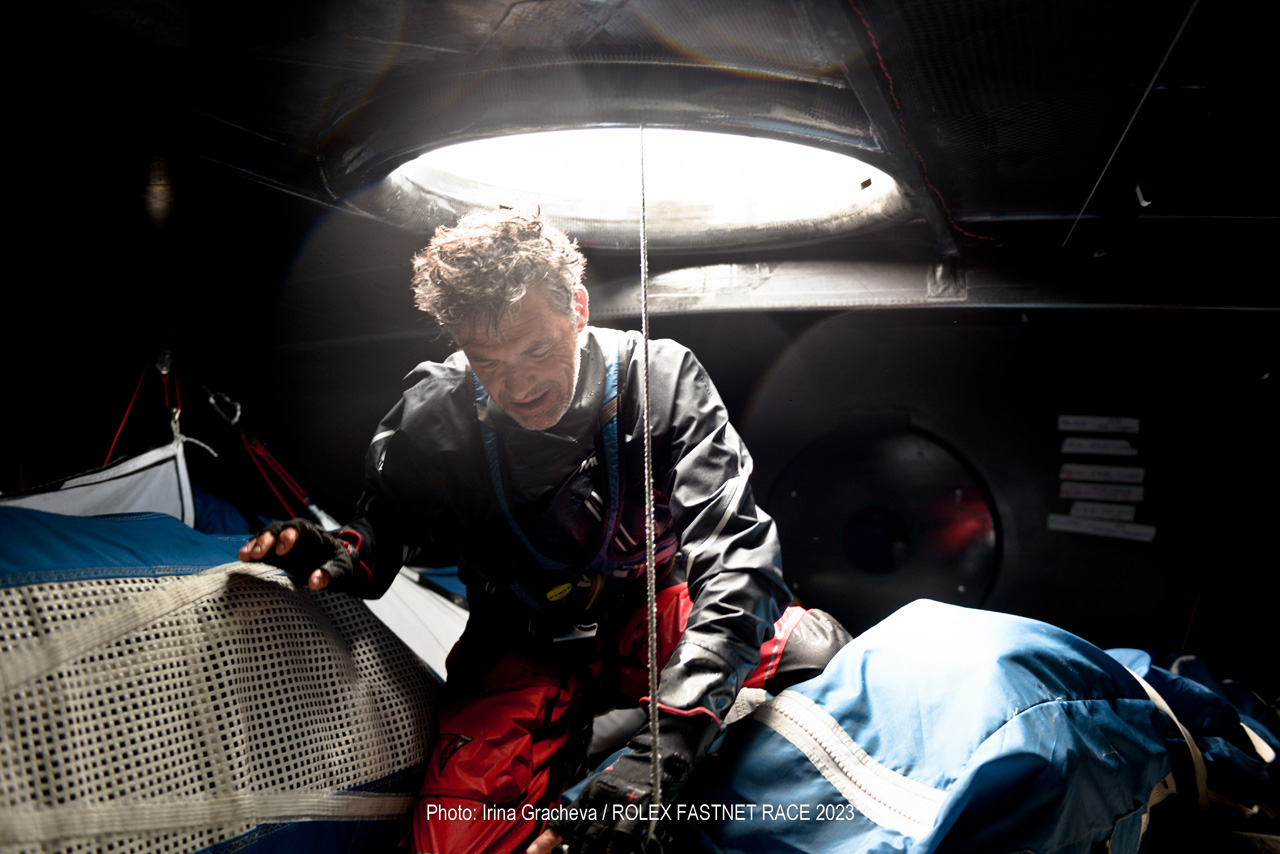
The start is never a simple task in short-handed sailing. Safety is the primary goal here. Personally, I find satisfaction in positioning myself strategically at the start line, launching off in a good rhythm and a favorable position. The start of this race was a decently conservative start, although I am not entirely satisfied with it. Five minutes before the start I was in a perfect position, but I gave away a lot of space by the moment of the start, perhaps being unnecessarily cautious. I opted for the safest solution, as starboard gale-wind starts can bring surprises. Even after the start, we couldn’t clear ourselves properly. We lost both height and speed. This is where the absence of those established settings became apparent. Calibration, signals, pilot adjustments, sail selection… These still require a lot of work.
Nevertheless, Nándi and I quickly found our rhythm, confidently maneuvering in the stormy winds of the Solent without any technical problems. It was a true coastal sailing experience, demanding a high level of technical and tactical knowledge. Personally, I enjoy these situations where I can see the course with my own eyes. Of course, there’s still room for improvement here.
A fundamental aspect of short-handed sailing is that only the helmsman’s role can be substituted. In today’s context, autopilots, given precise configurations, can expertly guide a boat. The meticulous process of calibration and pilot fine-tuning will be the prime focus of the coming training phase. Regrettably, during maneuvers, I found myself compelled to steer partially or completely manually, a circumstance that would have incurred an even greater handicap had it been under single-handed conditions. Fortunately, we possess all the knowledge and tools to progress in this area; only a few more hours and a few more miles of sailing is needed to accomplish it.
Upon exiting the Solent, we were confronted with even more demanding conditions. The three to four knot current against the occasional winds exceeding 40 knots created a complex course. Personally, I experienced this segment with a positive perspective. I never doubted the boat for a moment; we tackled the obstacles with absolute confidence. This achievement is substantial and provides a reassuring outlook for the future.
As we seamlessly integrated into the rhythm of the race, the forthcoming phase grew progressively captivating. The current gradually diminished and shifted direction, amplifying the significance of strategic positioning. Like many others, we opted for a coastal tacking strategy. In this maneuver, we both advanced and lost ground in comparison to the leading foiling boats. The distinction between success and improvement often hinges on just a few degrees, fractions of speed and responsiveness. I am certain it’s still within the boat’s capabilities; we just need to bring it out. Refinements in sail adjustments, a new J3 sail, and the activation of the ballast system will surely provide us with a competitive edge. Reflecting on the routing, tactically, we didn’t leave much on the table in this stretch, just a couple of miles.
The next strategic decision revolved around navigating one of the largest TSS zones near the English coast. In line with the majority, we opted for a northern detour around this region. The diminishing wind posed challenges in terms of sail selection. We opted for the more labor-intensive approach, hoisting the Code 0 alongside the full mainsail for this relatively short section. It was an enjoyable ride as the sails were set, yet unfortunately, it highlighted the principle that in solo sailing, maintaining a consistent average speed outweighs momentary top speeds. Upon critical analysis, it is evident that we sacrificed a bit with this maneuver.
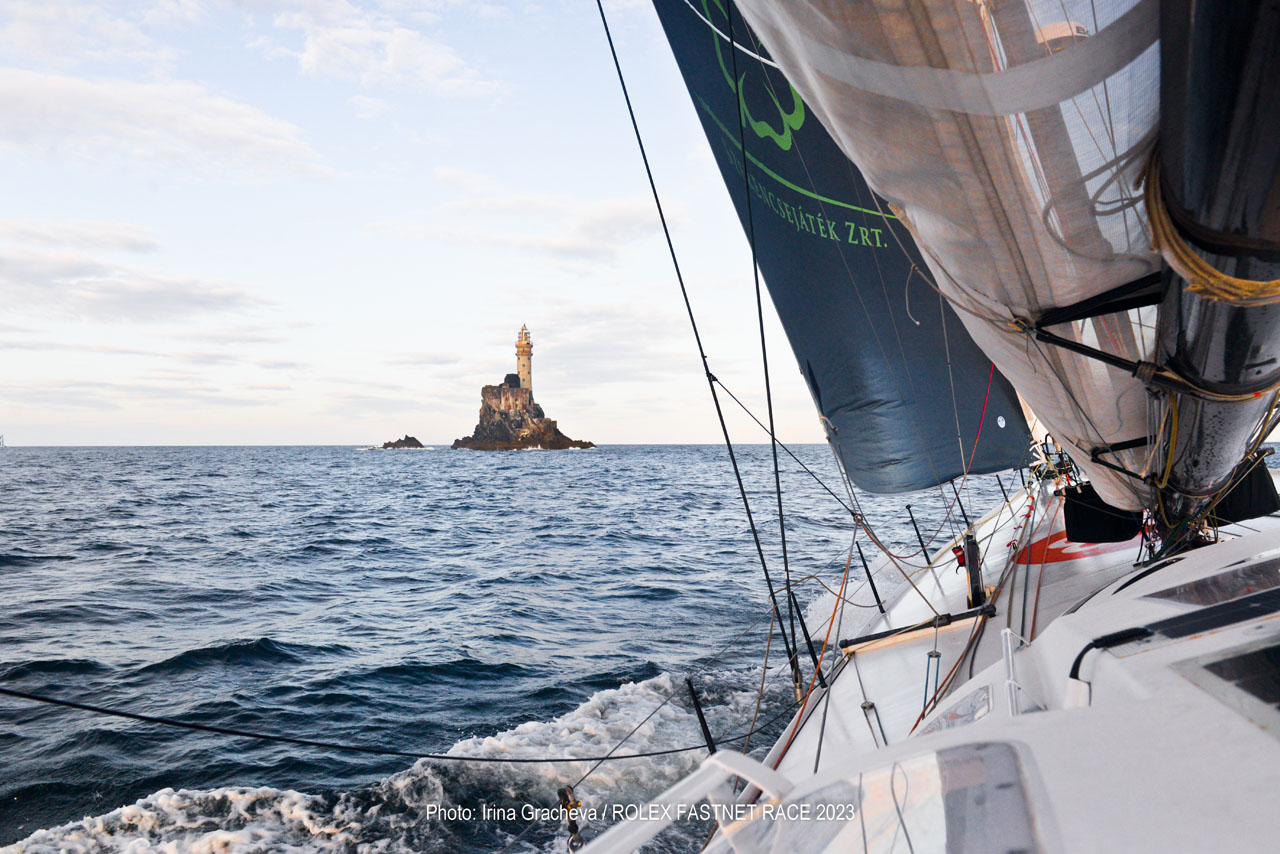
The wind began to weaken gradually, prompting strategic positioning. The fundamental principle in light winds is to sail the shortest path toward the new wind, regardless of the next mark. This was our course of action as well; unfortunately, the shortest route for us was longer than for those directly ahead. The new weather system progressed from west to east, causing those in front of us to enter the new wind sooner. The saying “the rich are getting richer” certainly applied. While we did catch the new breeze, propelling us toward the Fastnet Rock, the weather system had moved on by the time we arrived. We circumvented the Fastnet’s TSS zone in near calm conditions, all the while observing the boats ahead of us sailing briskly with the west-to-east system. This marked the beginning of a new race for us.
Navigating in light downwind conditions, we worked to find optimal wind and make positive shifts in our favor. Engaging in an enjoyable competition with nearby boats, we executed numerous maneuvers, each serving as valuable practice. During the night watch, I even sailed solo at times, using the opportunity to test the new deck layout. It’s worth noting that we required an A2 spinnaker, which unfortunately was absent from our inventory. Instead, we utilized an older A3 Cuben Fiber genoa from the Aviva era, which is not the fastest or most modern sail. The upside is that there is ample room for improvement in this area.
Approaching the finish line, the role of current tactics became increasingly important. On the Adrena (navigation software) display, the wind map was replaced by the current map. Alongside executing positive tacks, we endeavored to utilize the current to our advantage. Picture a network of small streams between nearshore islands, protrusions, and shallows. If navigated accurately, these currents can add an extra 1-1.5 knots of speed, and at times, we had to seek shelter in more protected areas to minimize the strong counterflow. We harnessed these elements through numerous efforts and maneuvers, progressively closing the gap with those ahead of us.
Eventually, we crossed the finish line at 1 o’clock in the morning after sailing for 3 days and 10 hours, securing the 35th position. All in all, I believe it was a decent performance. We definitely achieved our goal. I could say we should be satisfied, but unfortunately, I’m not the type who easily settles. I’m already looking at the next steps, the short-term achievements I can reach and areas where I can improve.
The next race is Le Défi Azimuth, a competition that will be similar in terms of distance and time. I’m eagerly looking forward to taking the experiences gained here, advancing a level higher, and stepping forward with a deeper understanding.
